Powered By Blogger

Tuesday, 11 March 2014

“Man does not live by bread alone, but by every word that comes from the mouth of God.”

FIRST SUNDAY IN LENT – YEAR A 2014       St. Thomas More, Toronto


Jesus answered “Man does not live by bread alone, but by every word that comes from the mouth of God.”

Lent is all about healing what has been called the “wound of knowledge” i.e. the Fall of Man or in J.H. Newman’s words the “aboriginal calamity” – our rebellion against God’s Word.

St. Paul describes the destiny of the human race as the tale of two “types” of human - the first man, Adam, and the new Adam, Jesus (1 Corinthians 15:21-22; 45-59).  Considering the Fall of Man into sin and death Newman in his Apologia Pro Vita Sua (his defense against the charge of dishonesty) held that the existence of God had always been as certain to him as his own personal existence but: “the world seems simply to give the lie to that great truth, of which my whole being is so full.”  He went on to say that it is as if: “I looked in a mirror and, and did not see my face . . . when I look into this living busy world, and see no reflection of its Creator.”

His argument goes on: “if there be a God, since there is a God, the human race is implicated in some terrible aboriginal calamity.” 

Just as the evidence of the Big Bang at creation is a virtual certainty to scientists today (by the way –  the Big Bang Theory was formulated first by a Jesuit priest and condemned by the Soviet Union) so evidence of the “Big Crash” or the Fall of Humanity is all around for us to see – the effects are seen both in our human sin and in the beautiful but broken world.

St. Paul’s argument in the Epistle to the Romans read today is built on a series of contrasts between “one person” and “the many” or “all.” By one person’s disobedience, sin and condemnation entered the world, and death came to reign over all. By the obedience of another one, grace abounded, all were justified, and life came to restore all.

This is the drama that unfolds in today’s First Reading and in the Gospel.
Formed from the clay of the ground and filled with the breath of God’s own Spirit, Adam was a son of God (Luke 3:38), created in his image (Genesis 5:1-3). He was crowned with glory and given dominion over the world and the protection of angels (Psalms 8:6-8; 91:11-13). The first Adam (Hbr. “human”) was made to worship God - to live not by bread alone but in obedience to every word that comes from the mouth of the Father. Here is the rub.

Adam put the Lord his God to the test. He gave in to the serpent’s temptation, trying to seize for himself all that God had already promised him. In contrast, in his hour of temptation, Jesus prevailed where Adam failed in accepting the will of God as best for the world.

For Catholics it is essential that we accept the Word of God as interpreted by the Magisterium, teaching office of the Church, the infallible authority i.e. that which is taught in faith and morals is to be accepted by every Catholic Christian. No matter how hard this may be and however our human reason may strain against it, we are committed.

Newman explained the nature of infallibility (a word which, in English at least, has unfortunate implications). Infallible teaching simply means that the Church will not fall because of the teaching of the Church, we have God’s assurance that “the gates of Hell” will not prevail against the Church and her teaching.  It does not mean that any human being including those who exercise the Magisterium of the Church are without sin. Pope Francis has made this very clear while upholding Church teaching on faith and morals.

Newman agrees as do Catholic teachers generally that “truth is the real object of our reason” and so there is no conflict between faith and reason or faith and science – a trumped up conflict imagined by some in the 19th century and promoted today by Dawkins and the “New Atheists”. Right reason, Newman insists, when “correctly exercised” arrives at religious truth as well as scientific facts.

Unfortunately, he says:  “reason as it acts in fact and concretely in fallen man” has “ a tendency towards simple unbelief.”  This is due to what he calls “ the all-corroding, all-dissolving skepticism of the intellect” which leads to “ the anarchical condition of things.”

In a strange way this very anarchy and fallen-ness is a witness to the truth of God. We know something is very wrong and only the Creator can fix it.  What is needed as Newman puts it is “a supereminent prodigious power sent upon earth to encounter and master a giant evil.”

This, of course, is the Incarnate Word of God, Jesus Christ, made manifest to the world since his resurrection in his body – the Catholic Church – through her sacraments and indefectible teaching, inn her magisterial interpretation of Sacred Scripture and Sacred Tradition, the two lungs of the Body of Christ. Because man cannot, in the words of the Gospel, “live by bread alone” the teaching, liturgy and practice of the Church express the life of the Sacred Heart of Christ and of his life-giving body and blood which nourish us when we are penitent and allow our own human reason to find its object in the truth of God.

Still we find that we sin after the pattern of Adam’s transgression. Like Adam, we let sin in the door (Genesis 4:7) when we entertain doubts about God’s promises and/or the Magisterial teaching on faith and morals, or when we forget to call upon our Lord in our hours of temptation. The Fall has its implications for all of us and so in Lent we turn in a special way to God’s mercy and attempt to conform our wills more closely to God’s will and reason for us and for the world.

The grace won for us by Jesus’ obedience means that sin is no longer our master as much as it is rampant in the world.  As we begin this season of repentance, we are sure of God’s compassion, that God can and will create a new heart within us (Romans 5:5; Hebrews 8:10).  

Fr. John Hodgins


Saturday, 8 March 2014

Why is a traditional English translation of the Roman Canon used in the Ordinariate rite for Mass?

Since the most striking difference for some Anglicans attending Ordinariate Rite Mass for the first time is the use of the Roman Canon in traditional (hieratic) English, I thought that it would be good to have a look again at the Eucharistic Prayer in the very first Book of Common Prayer (1549) in comparison with the present Roman Canon and the Ordinariate rite.


Following is the original text of Cranmer's BCP Eucharistic Prayer in English with comparisons to the English Ordinariate Use Canon, a translation of the Roman Canon which has been used in almost this exact form by Anglo-Catholics for well over 100 years and is found in both the English and American Missals as well as other Anglican books.


* NOTES IN THE TEXT OF THE CANON ARE IN BOLD TYPE.

The BCP canon or eucharistic prayer begins with a rubric directing the Priest to turn to the altar. Assuming that he has been facing the people for the dialogue this would the ancient and continuous practice of the ad orientem position i.e. facing East with the people.

THE EUCHARISTIC PRAYER OR CANON OF THE MASS (BCP 1549)

¶ Then the Priest, turnyng hym to the Altar, shall saye or syng, playnly and distinctly, this prayer folowyng:

ALMIGHTIE and everlivyng GOD, whiche by thy holy Apostle haste taught us to make prayers and supplicacions, and to geve thankes for al menne:

* COMMEMORATION OF THE LIVING AS IN THE ROMAN CANON.

We humbly beseche thee moste mercyfully to receive these our praiers, which we offre unto thy divine Majestie, beseching thee to inspire continually the universal churche with the spirite of trueth, unitie, and concorde: And graunt that al they that do confesse thy holy name, maye agree in the trueth of thy holye worde, and live in unitie and godly love. 

Speciallye we beseche thee to save and defende thy servaunt Edwarde our Kyng, that under hym we maye be Godly and quietly governed. And graunt unto his whole counsaile, and to all that he put in auctoritie under hym, that they maye truely and indifferently minister justice, to the punishemente of wickednesse and vice, and to the maintenaunce of Goddes true religion and vertue. 

Geve grace (O henvenly father) to all Bishoppes, Pastors, and Curates, that thei maie bothe by their life and doctrine set furthe thy true and lively worde, and rightely and duely administer thy holy Sacramentes: and to al thy people geve thy heavenly grace, that with meke heart and due reverence they may heare and receive thy holy worde, truely servyng thee in holynes and righteousnes all the dayes of their life: 

And we most humbly beseche thee of thy goodnes (O Lorde) to coumfort and succour all them, whyche in thys transytory life be in trouble, sorowe, nede, syckenes, or any other adversitie. And especially we commend unto thy mercifull goodnes, this congregacion which is here assembled in thy name, to celebrate the commemoracion of the most glorious death of thy sonne: 

*  THE FOLLOWING IS A CONTINUATION OF THE ANCIENT INVOCATION OF THE BLESSED VIRGIN AND ALL THE SAINTS  DATING TO THE FIRST CENTURIES OF THE CHURCH - THE COMMUNICANTES 


And here we do geve unto thee moste high praise, and heartie thankes, for the wonderfull grace and vertue, declared in all thy sainctes, from the begynning of the worlde: 

And chiefly in the glorious and moste blessed virgin Mary, mother of thy sonne Jesu Christe our Lorde and God, and in the holy Patriarches, Prophetes, Apostles and Martyrs, whose examples (O Lorde) and stedfastnes in thy fayth, and kepyng thy holy commaundementes, graunt us to folowe. 

We commend unto thy mercye (O Lorde) all other thy servauntes, which are departed hence from us, with the signe of faith, and nowe do reste in the slepe of peace: Graunt unto them, we beseche thee, thy mercy, and everlasting peace, and that, at the day of the generall resurreccion, we and all they which bee of the misticall body of thy sonne, may altogether be set on his right hand, and heare that his most ioyfull voice: 

Come unto me, O ye that be blessed of my father, and possesse the kingdom, whiche is prepared for you from the begynning of the worlde: Graunt this, O father, for Jesus Christes sake, our onely mediatour and advocate.

*  THIS PORTION OF THE CANON IS PATTERNED ON THE HANC IGITUR OF THE ROMAN CANON INCLUDING THE MANUAL SIGNS OF THE CROSS TO BLESS AND SANCTIFY.

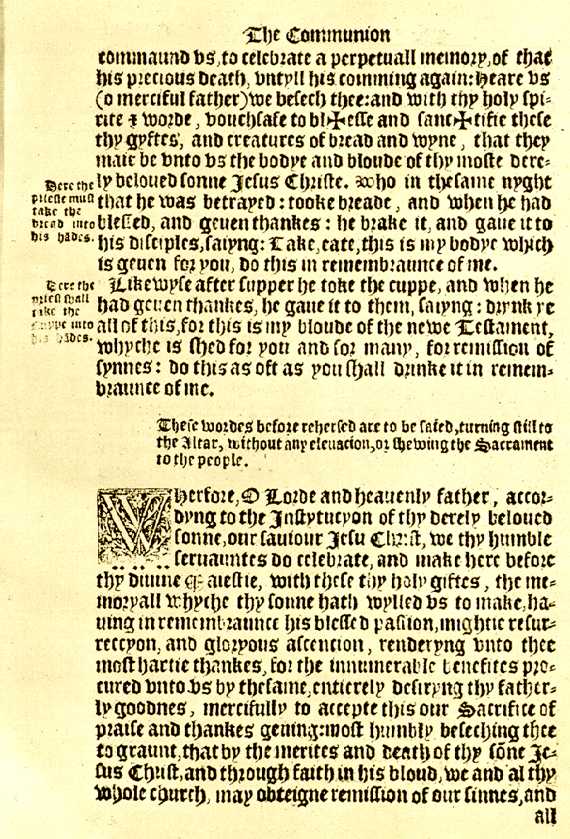
O God heavenly father, which of thy tender mercie diddest geve thine only sonne Jesu Christ to suffre death upon the crosse for our redempcion, who made there (by his one oblacion once offered) a full, perfect, and sufficient sacrifyce, oblacion, and satysfaccyon, for the sinnes of the whole worlde, and did institute, and in his holy Gospell commaund us, to celebrate a perpetuall memory of that his precious death, untyll his comming again: Heare us (O merciful father) we besech thee; and with thy holy spirite and worde, vouchsafe
______________________________________________________________

* COMPARE THE FOLLOWING TEXTS . . .


CRANMER'S ORIGINAL PRAYER:
to blesse and sanctifie these thy gyftes, and creatures of bread and wyne, that they maie be unto us the bodye and bloude of thy moste derely beloved sonne Jesus Christe. 


LATIN OF THE ROMAN CANON:
benedictam adscriptlam raltam rationabilem acceptabilemque facare digneris: ut nobis Corpus, et Sanlguis fiat dilectissimi Filii tui Domini nostri Jesu Christi 


AN ENGLISH TRANSLATION
to bless approve, ratify, make worthy and acceptable; that it may become for us the Body and Blood of Thy most beloved son Jesus Christ our Lord.


ORDINARIATE RITE
in all things to make this oblation blessed, approved, and accepted, a perfect and worthy offering; that it may become for us the Body and Blood of thy dearly beloved Son, our Lord Jesus Christ.
______________________________________________________________

Who in the same nyght that he was betrayed: tooke breade, and when he had blessed, and geven thankes: he brake it, and gave it to his disciples, saiyng: Take, eate, this is my bodye which is geven for you, do this in remembraunce of me.

Likewyse after supper he toke the cuppe, and when he had geven thankes, he gave it to them, saiyng: drynk ye all of this, for this is my bloude of the newe Testament, whyche is shed for you and for many, for remission of synnes: do this as oft as you shall drinke it, in remembraunce of me.


The Mass, from a 15th C, Prymer

Here the priest must take the bread into his handes.

Here the priest shall take the Cuppe into his handes.


WHERFORE, O Lorde and heavenly father, accordyng to the Instytucyon of thy derely beloved sonne, our saviour Jesu Christ, we thy humble servauntes do celebrate, and make here before thy divine Majestie, with these thy holy giftes, the memoryall whyche thy sonne hath wylled us to make, havyng in remembraunce his blessed passion, mightie resurreccyon, and gloryous ascencion, renderyng unto thee most hartie thankes, for the innumerable benefites procured unto us by the same, entierely desiryng thy fatherly goodnes, mercifully to accepte this our Sacrifice of praise and thanksgiving: 

most humbly beseching thee to graunt, that by the merites and death of thy sonne Jesus Christ, and through faith in his bloud, we and al thy whole church, may obteigne remission of our sinnes, and all other benefites of hys passyon. And here wee offre and present unto thee (O Lorde) oure selfe, oure soules, and bodies, to be a reasonable, holy, and lively sacrifice unto thee: 

humbly besechyng thee, that whosoever shalbee partakers of thys holy Communion, maye worthely receive the most precious body and bloude of thy sonne Jesus Christe: and bee fulfilled with thy grace and heavenly benediccion, and made one bodye with thy sonne Jesu Christe, that he maye dwell in them, and they in hym.

*  THE ABOVE LANGUAGE IS CLEAR INDICATION OF THE REAL PRESENCE OF CHRIST AND THE SACRAMENTAL RECEPTION OF HIS BODY AND BLOOD.

And although we be unworthy (through our manyfolde synnes) to offre unto thee any Sacryfice: Yet we beseche thee to accepte thys our bounden duetie and service, and commaunde these our prayers and supplications,

*  FOLLOWING IS CRANMER'S INCLUSION OF AN ANCIENT PART OF THE EUCHARISTIC PRAYER PRESERVED IN THE ROMAN CANON AND ALSO HERE IN THE FIRST BCP CANON OF THE MASS.

by the Ministery of thy holy Angels, to be brought up into thy holy Tabernacle before the syght of thy dyvine majestie; not waiyng our merites, but pardonyng our offences, through Christe our Lorde, by whome, and with whome, in the unitie of the holy Ghost: all honour and glory, be unto thee, O father almightie, world without ende. Amen.

* OUR FATHER / THE LORD'S PRAYER IN THE SAME SITUATION AS THE ROMAN CANON. THIS WAS LATER CHANGED

Let us praye.

As our saviour Christe hath commaunded and taught us, we are bolde to saye. Our father, whyche art in heaven, halowed be thy name. Thy Kyngdome come. Thy wyll be doen in yearth, as it is in heaven. Geve us this daye our dayly breade. And forgeve us our trespaces, as wee forgeve them that trespasse agaynst us. And leade us not into temptacion.
The aunswere. But deliver us from evill. Amen.

Then shall the priest saye.

* THE FOLLOWING WORDS SPEAKING OF THE PASCHAL SACRIFICE ARE IN CONFORMITY WITH THE ROMAN CANON.

The peace of the Lorde be alwaye with you.

The Clerkes. And with thy spirite.

The Priest. Christ our Pascall lambe is offred up for us, once for al, when he bare our sinnes on hys body upon the crosse, for he is the very lambe of God, that taketh away the sines of the worlde: wherfore let us kepe a joyfull and holy feast with the Lorde.


* NOTICE THE FOLLOWING WORDS OF ADMINISTRATION OF THE BLESSED BODY AND BLOOD OF CHRIST CONFORM TO THE ROMAN CANON AND THE DOCTRINE OF THE REAL PRESENCE. THESE WORDS WERE CHANGED IN LATER PRAYER BOOKS REFLECTING THE CALVINISTIC AND ZWINGLIAN DRIFT THAT CRANMER AND OTHERS WERE FOLLOWING.

¶ And when he delivereth the Sacramente of the body of Christe, he shall say to every one these words.

The body of our Lorde Jesus Christe whiche was geven for thee, preserve thy bodye and soule unto everlasting lyfe.

And the Minister delivering the Sacrament of the bloud, and geving every one to drinke once and no more, shall say,

The bloud of our Lorde Jesus Christe which was shed for thee, preserve thy bodye and soule unto everlastyng lyfe.

If there be a Deacon or other Priest, then shal he folow with the Chalice: and as the Priest ministereth the Sacrament of the body, so shal he (for more expedition) minister the Sacrament of the bloud, in fourme before written.

From this comparison of the Roman Canon with the Ordinariate rite and the first Book of Common Prayer we see many of the common elements which have been preserved in all three.

The real deviations in eucharistic prayers followed progressively through the history of Anglicanism (1552 - 16620 and to the point now that many of the rites in use around the world today vary greatly from these three similar and comparable canons of the Mass.

Anglo-Catholics, of course, find the Ordinariate rite very similar to the canons they have used since the nineteenth century.  

Thursday, 6 March 2014

The Holy Father's prayer intentions for Lent and Easter


PRAYER INTENTIONS OF POPE FRANCIS

March

  • Respect for Women.  That all cultures may respect the rights and dignity of women.
  • Vocations.  That many young people may accept the Lord’s invitation to consecrate their lives to proclaiming the Gospel.

April

  • Ecology and Justice.  That governments may foster the protection of creation and the just distribution of natural resources.
  • Hope for the Sick.  That the Risen Lord may fill with hope the hearts of those who are being tested by pain and sickness. 

Tuesday, 4 March 2014

Mass of Thanksgiving Homily by Fr. Scott McCaig

Mass of Thanksgiving
Dec 15/ 2013
St. George's Catholic Church, Ottawa, ON


It is my great privilege to welcome all of you, all the faithful, here today for this Mass of thanksgiving
– A very special welcome to Msgr Jeffery Steenson; who is the Ordinary of the Ordinairiate of the Chair of St. Peter.
·      Your presence here, Msgr, is a particular blessing.
·      All of us, but perhaps especially those of us who have come into full communion with the Catholic Church, are very grateful for your powerful and beautiful homily yesterday at the ordination.
·      It is not difficult to see why the Holy Father entrusted you with this precious responsibility.
- A special welcome also to the priests and religious present here, especially the Queenship of Mary community, who have been particularly close and supportive of this parish and its aspirations for years.

Today is, of course, a day of great rejoicing! Not only is it Gaudete Sunday – wherein we rejoice at the approach, the imminent Advent of our God,
·      our God who has kept his word,
·      who has fulfilled all his promises to humanity
·      and in a way more marvellous than even the greatest prophet (John the Baptist) could imagine!

But we also rejoice that he has given us these wonderful priests to shepherd and lay down their lives for his beloved people…

·      Fr. Doug
·      Fr. John
·      Fr. Kipling

Thank you for the gift of your lives for His people,

And for the many sacrifices of love you made in bringing them all the way home into the sheepfold of the Catholic Church


A) When I think of the priesthood, I cannot help but think about the Servant of God Catherine Doherty, the foundress of Madonna House, a mystic of the first degree who toiled right here in our own backyard…


Herself a woman who came into full communion with the Catholic Church after much searching and many trials, she had a penetrating mystical understanding of the priesthood.

- Catherine loved the priesthood. Her concern for priests and reverence for their office was obvious and sincere.

- But she was not naïve. She was well aware of all the faults and shortcomings of priests, probably more than most people. Indeed, she suffered a great deal in her life because of them.

- But she saw with the eyes of faith what most of us miss.
- Our Lord graced her to see beyond the priest himself, whoever he might be, into the very mystery of the priesthood.

- Living through the Communist Revolution, where priests were easy victims for slaughter, [Catherine] realized that she would crawl on her belly to any priest for the graces of the sacraments that she so missed during those horrendous days. She realized in a very concrete manner that her life truly was lived between two Masses

- She relates one story from that time of how some communist soldiers walked into a church in a certain city and shot the last priest as he distributed Holy Communion, stepping on the Sacred Species as they left.
- As the last crumbs of the desecrated Body of the Lord were distributed, a stark realization set in to everyone present. Having no more priests meant no more Jesus in the Eucharist.

- As you listen to her recount this experience you can almost feel what those people might have felt. How precious the Eucharistic Presence of Jesus would have seemed to them at that moment. And how precious the priesthood would have seemed, through which the Eucharistic Jesus came to them.
- How precious the Sacrament of Reconciliation and the other Sacraments now that there were no longer any priests to minister them.
- How vacant the church must have felt! You can’t help but feel along with them a whole new appreciation for the incredible treasure and gift of what it means to have a priest.
- The mystery of the priesthood suddenly became very real to them!

B) The Mystery of Priesthood

- So what is this mystery?

Pope Pius XII put it this way:

[T]he priesthood is a great gift of the Divine Redeemer, Who, in order to perpetuate the work of redemption of the human race which He completed on the Cross, confided His powers to the Church which He wished to be a participator in His unique and everlasting Priesthood. The priest is like "another Christ" because he is marked with an indelible character making him, as it were, a living image of our Saviour. The priest represents Christ Who said "As the Father has sent me, I also send you"; (John 20:21) "he who hears you, hears me" (Luke 10:16). (Apostolic Exhortation To The Clergy Of The Entire World On the Development of Holiness in Priestly Life, no. 7)

- The Catechism of the Catholic Church relates that “He is configured to Christ by a special grace of the Holy Spirit (CCC1581) and shares in the One Priesthood of Jesus, the only true Priest (CCC1544-45)
- Pope Benedict put it even more succinctly: Through the sacrament [of Holy Orders] the priest is totally inserted into Christ (Pope Benedict XVI, Letter to Clergy for Year of Priests, 2009).
- Because of this the priest makes present and mediates the Priesthood of Jesus to the world.

- Another way of saying this is that Jesus is still exercising His Priestly ministry in the world, only now He is doing it though his priests.
- When a priest celebrates any Sacrament, it is Jesus who is acting through him.
- When a priest says the words of absolution in confession it is Jesus who is absolving them.
- When a priest pronounces the words of consecration at Mass – it is Jesus who is consecrating the elements.
·      Blessed Pope John Paul II made this point clearly in His encyclical on the Eucharist in 2000:

“This is My body which will be given up for you This is the cup of My blood, poured out for you...” The priest says these words, or rather he puts his voice at the disposal of the One who spoke these words in the Upper Room and who desires that they should be repeated in every generation by all those who in the Church ministerially share in His priesthood. (Ecclesia de Eucharistia, Introduction)

-       What is this mystery? It is the mystery of the ongoing priestly ministry of Jesus right here in our midst –
-       Jesus, who in His priestly love could not bear to be separated from us
-       Jesus, who is still healing, teaching, forgiving, and feeding us with His own divine life – through his priests…
-       What an incredible gift & mystery!


C) Pope Benedict XVI quoted St. John Vianney liberally in discussing the mystery and importance of the priesthood in his letter to clergy during the Year of Priests in 2009:
The Curé of Ars was very humble, yet as a priest he was conscious of being an immense gift to his people: “A good shepherd, a pastor after God's heart, is the greatest treasure which the good Lord can grant to a parish, and one of the most precious gifts of divine mercy". He spoke of the priesthood as if incapable of fathoming the grandeur of the gift and task entrusted to a human creature: "O, how great is the priest! ... If he realised what he is, he would die. ... God obeys him: he utters a few words and the Lord descends from heaven at his voice, to be contained within a small host". Explaining to his parishioners the importance of the Sacraments, he would say: "Without the Sacrament of Holy Orders, we would not have the Lord. Who put Him there in that tabernacle? The priest. Who welcomed your soul at the beginning of your life? The priest. Who feeds your soul and gives it strength for its journey? The priest. Who will prepare it to appear before God, bathing it one last time in the blood of Jesus Christ? The priest, always the priest. And if this soul should happen to die [as a result of sin], who will raise it up, who will restore its calm and peace? Again, the priest. ... After God, the priest is everything! ... Only in heaven will he fully realise what he is". These words, welling up from the priestly heart of the holy pastor, might sound excessive. Yet they reveal the high esteem in which he held the Sacrament of the Priesthood. He seemed overwhelmed by a boundless sense of responsibility: "Were we to fully realise what a priest is on earth, we would die: not of fright, but of love. ... Without the priest, the passion and death of our Lord would be of no avail. It is the priest who continues the work of redemption on earth. ... What use would be a house filled with gold, were there no one to open its door? The priest holds the key to the treasures of heaven: it is he who opens the door: he is the steward of the good Lord; the administrator of His goods. ... Leave a parish for twenty years without a priest, and they will end by worshipping the beasts there. ... The priest is not a priest for himself, he is a priest for you".

D) The Love of God

- St. John Vianney also gives us one of the most well-known phrases about the priesthood – a phrase which takes us even deeper into the mystery of the priesthood:

…the priesthood is the love of the heart of Jesus” (CCC #1589).

- St Ambrose said:

He made them [priests] the vicars of His love.

- This is the mystery of the priesthood at its very core! Priesthood is about God’s love! It is the love of the heart of Jesus!

- The priesthood is the love of the heart of Jesus because it was love that compelled Jesus to become our High Priest in order to bring about our redemption. And it is this same love that compels him to continue to call weak and sinful men to continue his work of redemption by sharing in the saving power and grace of his own priesthood.

- It was love that compelled him to leave aside his glory and humble himself to come among us as a man. Lovers need to be with their beloved and so he needed to be with us. And it is this same love that compels him to make his priestly love humbly visible again to his beloved bride, the Church, through his priests.

- It was love that compelled Jesus to teach, heal, forgive, and sanctify those to whom he was sent. And it is his love that flows through his priests as he continues to teach, heal, forgive, and sanctify his people through them.

- It was love that compelled him to suffer for us and to let his heart be pierced. And it is love that compels him to call men to share the sufferings of his priestly ministry. Like Jesus, the heart of a priest will also be pierced. He, too, will become “victim” as well as priest. A priest is called to share in the self-sacrificing love of Jesus.

- It was love that compelled Jesus to offer to the Father the perfect sacrifice of his death and resurrection for us. And it is this same love that compels him to re-present the perfect offering of his paschal sacrifice to every time and place in the Mass through the ministry of his priests.

- It was love that compelled him to give himself to us in the Eucharistic banquet so that he might always dwell with us and draw us into communion with himself. And it is this same love that compels him to continually offer his Eucharistic love and Presence to the world through the hands of his priests.

- This Love of Jesus is so great that even the weakness, broken humanity, or sinfulness of a priest cannot stop it:

1584 St. Augustine states this forcefully: As for the proud minister, he is to be ranked with the devil. Christ's gift is not thereby profaned: what flows through him keeps its purity, and what passes through him remains dear and reaches the fertile earth. . . . The spiritual power of the sacrament is indeed comparable to light: those to be enlightened receive it in its purity, and if it should pass through defiled beings, it is not itself defiled.

Catherine Doherty learned this lesson from her mother early in life:  

In one incident she often recounted, they were visiting relatives in Poland, and she ventured forth on a walk in the midst of which she encountered a priest who had fallen drunk in the street. She ran home in great distress. Her mother had Catherine accompany her to the fallen priest, bring him to his house, and then when they had returned home, prepared an instruction for her daughter. She had Catherine gather some beautiful flowers from the garden and place them in a precious vase. Then she told her to go and get the potty used by Catherine's younger brother, clean it out, and bring it back. When Catherine did so, her mother placed the flowers in the potty and turned to her daughter, saying, "Catherine, the flowers are the beauty of the priesthood; they remain beautiful whether they are in a priceless vase or in a potty. Never confuse the priesthood with the human vessel." This was a lesson deeply imprinted in the heart of the young girl. So much so that when in later years, a new member priest of the Apostolate came to her to ask what his role was, what she wanted him to do, she turned to him and replied, "Your presence, Father. That is what we need."
(Voice of the Southwest. – Sept/Oct Edition, Sept. 27, 2009)

Having come to know these priests here - celebrating this Mass of Thanksgiving
-       And having the grace of being counted a friend to them…
-       I know them to be men of God
-       Men after his own heart!
-       I am so edified by them, and inspired to be a better priest because of their example
-       And I am so grateful to each of  them

-       But even more I am grateful to Jesus, Our Great High priest,
-       Who gives Himself to us through them
-       Who will minister and love us through them – so that even if they should struggle or stumble – His light and love would not be dimmed in the least…


E)  Fr. John, Fr. Doug, Fr. Kipling

Thank you for all the struggles, the searching, and the sacrifices that have brought you to this day…

But most of all, thank you for allowing Jesus to love us to the full – to incarnate His Sacred Heart, His burning Priestly love, in you and through you…


I pray our heavenly Mother Mary enfold you always in her tender mantle of  maternal love, protection, and intercession. Amen.