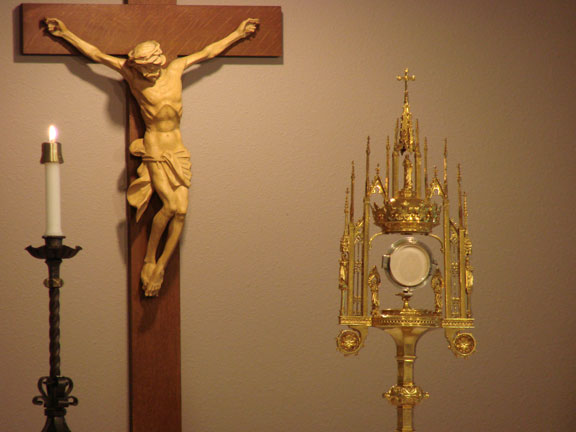
Saturday, 28 September 2013
Msgr Steenson in Canada
As a member of the Canadian Council of Catholic Bishops our Ordinary, though not a bishop, Msgr Steenson has a voice at their meetings. He also has warm friendships with a number of the bishops there who are friends of the CSP Ordinariate and the cause of Christian unity which it works toward.
St. Adele is a lovely place at any time of year but particularly colourful in the autumn. We pray that our bishops and our ordinary will be strengthened for service as they share prayer and fellowship.
May St. Michael the Archangel guard and protect them in their proclamation of the Gospel.
Wednesday, 18 September 2013
Updated Website for St Thomas More, Toronto
The website for the Toronto Anglican Ordinariate mission - St. Thomas More is:
http://www.thomasmorechurch.ca
You will find updated information about the community, Mass times, clips of choir music and information about Evangelium courses. Make our website a regular stop and give us your feedback.
http://www.thomasmorechurch.ca
You will find updated information about the community, Mass times, clips of choir music and information about Evangelium courses. Make our website a regular stop and give us your feedback.
You may also be interested in the Salt and Light interview in May with Msgr Steenson on the TV show
"Witness" if you have not seen it yet.
§ “We cannot go to heaven in featherbeds.”
—Life of Thomas More by William Roper; More to his children, c. 1510
Monday, 16 September 2013
Toronto Anglican Ordinariate Choir begins new season at St. Thomas More Mission, Sacré-Coeur Church
Here is the clip of an offertory motet for double choir, Ecce Vicit Leo by Peter Philips, sung by the St. Thomas More Anglican Ordinariate Choir at Sacré-Coeur Church in Toronto recently.
http://www.youtube.com/watch?v=6u98TpZ1cNs
Ecce vicit Leo de tribu Juda,
radix David aperire librum,
et solvere septem signacula eius. Alleluia.
Dignus est Agnus qui occisus est
accipere virtutem, et divinitatem,
et sapientiam, et fortitudinem, et honorem,
et gloriam, et benedictionem. Alleluia.
- Revelation 5: 5, 12 -
Behold, the Lion of the tribe of Judah,
the root of David, hath prevailed to open the book
and to loose the seven seals thereof. Alleluia.
Worthy is the Lamb that was slain
to receive power, and riches,
and wisdom, and strength, and honour,
and glory, and blessing. Alleluia.
St. Thomas More Mission,
Personal Ordinariate of the Chair of St. Peter
Sacré-Coeur Church,
Toronto, ON
"Anglican Patrimony in full communion with the Catholic Church."
SUNG MASS WITH FOUR PART CHOIR
EVERY SUNDAY AT 1:45 p.m.
Monday, 9 September 2013
EVANGELIUM course at Sacré-Coeur, Toronto
ORDINARIATE EVANGELIUM COURSE UNDERWAY . . . Still time to join the group.
Pope Francis announced this Spring that he was expanding the mandate of the Anglican Ordinariates for the New Evangelization.
Those who have been baptized in the Catholic Church but have never received the sacraments of Confirmation and First Communion my also prepare with and be received into full communion through the Ordinariates.
Of course, all non-Catholics are welcome as well. If you are baptized already you can join our Evangelium Group to explore the Catholic Faith with a view to reception. If not baptized we will work out an RCIA (Christian baptismal initiation) version of Evangelium for you.
This past week we covered the first five subjects (p. 1 - 10 of the Evangelium Participant's book) but those who would still like to join may contact us at peregrinusto@gmail.com.
With a review of the first subjects, you are ready to join our seekers group. We can provide you with a book. Sessions are every Sunday until October 6 with a view to reception before Advent this year.
We meet Sundays at 12:30 - 1:30 pm (just before the Anglican Use Sung Mass) at Sacré-Coeur Church, corner of Sherbourne and Carlton, Toronto. We are meeting in the parish hall.
Of course, all non-Catholics are welcome as well. If you are baptized already you can join our Evangelium Group to explore the Catholic Faith with a view to reception. If not baptized we will work out an RCIA (Christian baptismal initiation) version of Evangelium for you.
This past week we covered the first five subjects (p. 1 - 10 of the Evangelium Participant's book) but those who would still like to join may contact us at peregrinusto@gmail.com.
With a review of the first subjects, you are ready to join our seekers group. We can provide you with a book. Sessions are every Sunday until October 6 with a view to reception before Advent this year.
We meet Sundays at 12:30 - 1:30 pm (just before the Anglican Use Sung Mass) at Sacré-Coeur Church, corner of Sherbourne and Carlton, Toronto. We are meeting in the parish hall.
Sunday, 25 August 2013
The Real Presence of Christ is the Eucharist
At an Anglican Use wedding in Toronto recently, one which included a beautiful Byrd Sung Mass and traditional Anglican hymns, I had a conversation with a member of the Anglican Church of Canada who attended. He had sung for years in Anglo-Catholic parish choirs and is an observant Christian who has considered entering into full communion with the Catholic Church through the Ordinariate.
.

One of the stumbling blocks for him is the Catholic understanding of the Real Presence of Christ in the Holy Eucharist, Catechism of the Catholic Church (CCC), Part 2, Article 5. His Anglican view is that Christ is present but in a symbolic way. He is troubled with the teaching that the bread and wine of the eucharist truly and really become the body and blood of our Lord.
This is a difficulty that even many high church Anglicans, Lutherans and others share. The language of transubstantiation as laid out by the medieval scholastics and St. Thomas Aquinas is difficult to interpret in a secular and scientific age. The Catholic teaching that the substance of bread and wine truly become the body, blood, soul and divinity of our Lord Jesus Christ (CCC 1373-81) seems to stretch credibility as much as these people believe that Christ is present "spiritually".
This idea of a symbolic sacrament seems to be related to the often expressed notion that you can be "spiritual" without being religious. It is the vague notion that spirituality is what I feel at the moment and God is sort of around but not in any way that impinges on the "real" (read material) world.
The Catholic doctrine of the Real Presence is tied to a number of crucial teachings about the Church as the Body of Christ in the real world. I will list some of these crucial areas that the teaching of the Real Presence touches upon and will try to connect these essentials to what Anglicans and others believe.

1. THE COMMAND TO CONSUME THE
BODY OF CHRIST
Jesus, as recorded in the Gospel according to St. John, specifically, emphatically and, for Jewish believers, scandalously, said: "Unless you eat my flesh and drink my blood you have no life in you." (John 6:53)
Such a statement, particularly in light of the traditional Jewish teaching re. the sacredness of the human body and blood, is shocking and radical. The Jews of Jesus time on earth believed, as do many today, that to touch blood or a dead body makes one ritually unclean and there are many practices established to maintain respect for the body.
Any notion or even a reference to consuming any part of the body was anathema. Yet, St. John picks up and emphasizes the radical nature of Jesus' unique offering of himself and the sacramental reality that Jesus provides for those who will share in his life by means of physically and sacramentally consuming the substance of his life - his very body - in a dramatically real way.
The substance of Christ is offered in the Eucharistic sacrifice which, though made once for all on Calvary, is re-presented in all its spiritual reality in each Mass. Each Mass is the sacrifice of Christ made present once again for us. The substance of the sacrifice, Jesus himself, is present and by his own command is to be consumed so that we may be part of Him as He is of us. (CCC 1384-90)
The Catholic Church always hastens to add that the sacrifice of the Mass is an unbloody sacrifice because the "accidents", that is to say, the appearance, texture and the physical aspects of the bread and wine remain unchanged. However, the 'substance' is changed i.e. the category of medieval philosophy: 'substance' is used to identify the reality that the Eucharistic action is the presentation of the real body, blood, soul and divinity of Christ at the altar under the forms of bread and wine.
When theologians defined transubstantiation it was accepted by many philosophers and society at large that reality was that which participated most closely in the divine. This classical idealism placed less emphasis on the physical world - the accidents of shape, size, colour, etc. As with Plato, the real world is the world of ideas or forms - that is where the substance of things is defined, regardless of physical appearances. In recent centuries this view has been critiqued by many, but the Church has continued to hold that the Real Presence of Christ in the sacrament is a substantial presence according to these categories.
This is not to deny that there are other perspectives on the Real Presence. Theologians of the Eastern Churches do not, typically, use scholastic categories. For example, they speak of the Real Presence in terms of the eucharistic "Holy Mysteries" which cannot be fully comprehended or defined by the human mind. However, for all that different language and theology is employed, the presence of Christ is no less real in the Mass.
The Creator of the universe who brought us, our world and the cosmos into being from nothing is the same God whose power is effected through the ministry of a Catholic priest to change the substance of the bread and wine into the Body and Blood of his Son, Jesus the Christ (Messiah) at the Mass.
Is it any harder to believe in transubstantiation than it is to believe that God created us and the universe from nothing? Is the re-creation of fallen humanity through the sacrament of the Body and Blood of Christ any more difficult to believe than God's creation of the universe?
The Catholic faith in the real presence of Christ can be traced back to the earliest Church Fathers who interpreted St. John as meaning to convey what Jesus said: Eat my flesh, drink my blood, not symbolically but really and truly.
This transformation of bread and wine at the Mass into the reality of Christ is given by God in order that we can be really and truly re-made and incorporated into the real body of Christ. Our bodies and souls are nurtured by consuming with others, at Jesus' own command, not a symbol or some token of remembrance of his body but his actual, real and truly present body.
![]() |
| Blessed John Paul, offers Benediction of the Blessed Sacrament |
2. THE CATHOLIC CHURCH IS
THE BODY OF CHRIST
The ecclesiological meaning i.e. the understanding of what the Church is and how it grows organically is sustained and strengthened by the sacraments and is intimately tied to the presence of Christ in the Eucharist. Every Catholic is obligated, as part of the body of Christ, to join with the community of faith at Mass every Sunday and holy day of obligation.
Just as our bodies cannot be sustained without real food and drink, so the Catholic Christian cannot be sustained without the real body and blood of Christ. No pictures or symbols of food will sustain a hungry person and neither can some remembrance or symbolic representation maintain the body and soul of the Christian believer.
Is it any wonder that attendance at mainline Protestant churches in Canada is dwindling where the commitment to an obligation to be at the Eucharist is notional at best? Catholics have much work to do in the instruction of the faithful and building faith intellectually and morally but there is still a strong adherence to the obligation to celebrate Mass and to respect the real presence of Christ in the celebration and in the sacrament reserved for devotion and adoration.
One only needs to go into a downtown Catholic Church to see hundreds of people daily attending Mass, praying before the Blessed Sacrament or involved in devotions in the respectful silence which is rarely seen in Protestant buildings. In fact, there is a tangible sense of the real presence amongst those who are spiritually sensitive. This reality has often been remarked upon even by unbaptized or uncatechized people -- some of whom are drawn to become part of the Body of Christ by virtue of the silence and reverence found before the real presence of Christ in Catholic churches around the world.
![]() |
| The Blessed Sacrament is truly the Body of Christ presented under the form of Bread |
3. THE UNIVERSALITY OF THE
CATHOLIC FAITH
The presence in Catholic churches of the altar and the tabernacle where the Blessed Sacrament is kept with a light nearby is found around the world. In churches, chapels and cathedrals we find the same devotion to the Body of Christ, another factor in our understanding of the meaning of the real presence for Catholics and indeed for all people.
The structure of the Mass is so universal and well known by the faithful that we find people from all nationalities attending Mass in churches far from their own communities of origin. "Here comes everybody" is the description of the Catholic Church attributed to the famous Irish novelist James Joyce. This universality can be seen particularly in urban churches in every country where people of every race and nation are seen daily at Mass and devotion before the Blessed Sacrament. This is in stark contrast to the national, regional or ethnic divisions in most Protestant sects.
Jesus intended there to be one universal Church, the Body of Christ for the world. Divisions are not part of his will and prayer "that they all may be one" (John 17:21). The Blessed Sacrament of the one body of Christ not only symbolizes but makes present the reality of the Body of Christ on every continent and island around the world.
These are just three salient points to be made about the teaching and effects of the real presence of Christ for the Church and the world. Of course, the best way to contemplate and enter into this reality is to attend Mass and spend time before the transformative real presence of Jesus Christ. Every city has churches where one can find a quiet place to contemplate the greatest gift of all, the presence of the one true and living God in the body, blood, soul and divinity of Jesus Christ -- truly and substantially present to you.
Monday, 29 July 2013
Anglican implications of the new papal encyclical LUMEN FIDEI
For Anglicans and others seeking meaning in their lives through the light of the faith this letter from the Holy Father is an opportunity to deepen what is already shared with all Catholics. This encyclical is an illumination of the complementarity of reason with faith.
Addressing Enlightenment, modern and post-modern critiques of faith, the encyclical refers to Rousseau, Nietzsche and other critics of Christian faith. The Pope expands the conversation of faith with reason through references to science, sacred Scripture, the Fathers, philosophy and literature from Dante to Dostoyevsky.
The Encyclical lays out a universal claim which will appeal to many who see the emptiness of secularity and the dead-end that the spirit of the present age is leading to in some dying branches of Christian society -- those that once held to apostolic faith and order.
Pope Francis, using the theological insights of his predecessor Pope Benedict, collaborates to lay out markers on the path of faith for those who are seeking to find or deepen faith as well as for those who are involved in promoting the New Evangelization.
This magisterial teaching expresses the importance of faith through which we may perceive the transcendent love of God reaching out to us in the person of Christ as opposed to self-willed narratives of individualism or putative self-illumination. Lumen Fidei states:
"The light of faith is unique, since it is capable of illuminating every aspect of human existence. A light this powerful cannot come from ourselves but from a more primordial source: In a word, it must come from God. Faith is born of an encounter with the living God who calls us and reveals his love.
. . . . Transformed by this love, we gain fresh vision, new eyes to see; we realize that it contains a great promise of fulfillment and that a vision of the future opens before us . . . . We come to see that faith does not dwell in shadow and gloom; it is a light for our darkness. Dante . . . describes that light as a 'spark, which then becomes a burning flame and like a heavenly star within me glimmers' . . .
Echoing the language and reasoning with faith found in Chapter 5 of John Henry Newman's Apologia Pro Vita Sua, the encyclical builds on the writings of Newman which have so profoundly influenced Benedict's theology over the decades since Vatican II.
In an age which is paralyzed with cynicism and wedded to the cult of individualism, the clear announcement of God's incarnational love and the possibility of a personal relationship with the divine persons of the Triune God through the Body of Christ - the Catholic Church - is a clarion call to those who are floating on a sea of hopeless unbelief, fear or isolating spiritualities which look only within.
Rich in its references to classical thinkers, the papal letter also challenges the easy assumptions of the "New Atheism" while warmly affirming the sacramental life which nurtures those seeking meaning and fulness in an outward-looking life of love and service.
As the universal pastor, the Holy Father offers his reflections on the path of collaboration with God in the ministry of his one universal and apostolic Church. It is a message of welcome to all and a message which affirms the truths which both natural law and reason express in the many human traditions that reflect, in different ways, the one true light.
Many Anglicans, Protestants and others adrift on what some have called a "Sea of Faith" are looking for a sure harbour within which families and individuals can be nurtured after voyages that so many have found are uncharted and often misdirected.
In this encyclical which completes a cycle based upon the three theological virtues (love, hope and faith) begun by Pope Emeritus Benedict XVI, the Holy Father affirms that all relationships are truly seen only in the light of God's trinitarian self-giving love which sheds light on the path to hope and love, a path which all human individuals and societies must seek using reason in the light of faith.
Addressing Enlightenment, modern and post-modern critiques of faith, the encyclical refers to Rousseau, Nietzsche and other critics of Christian faith. The Pope expands the conversation of faith with reason through references to science, sacred Scripture, the Fathers, philosophy and literature from Dante to Dostoyevsky.
The Encyclical lays out a universal claim which will appeal to many who see the emptiness of secularity and the dead-end that the spirit of the present age is leading to in some dying branches of Christian society -- those that once held to apostolic faith and order.
Pope Francis, using the theological insights of his predecessor Pope Benedict, collaborates to lay out markers on the path of faith for those who are seeking to find or deepen faith as well as for those who are involved in promoting the New Evangelization.
This magisterial teaching expresses the importance of faith through which we may perceive the transcendent love of God reaching out to us in the person of Christ as opposed to self-willed narratives of individualism or putative self-illumination. Lumen Fidei states:
"The light of faith is unique, since it is capable of illuminating every aspect of human existence. A light this powerful cannot come from ourselves but from a more primordial source: In a word, it must come from God. Faith is born of an encounter with the living God who calls us and reveals his love.
. . . . Transformed by this love, we gain fresh vision, new eyes to see; we realize that it contains a great promise of fulfillment and that a vision of the future opens before us . . . . We come to see that faith does not dwell in shadow and gloom; it is a light for our darkness. Dante . . . describes that light as a 'spark, which then becomes a burning flame and like a heavenly star within me glimmers' . . .
Echoing the language and reasoning with faith found in Chapter 5 of John Henry Newman's Apologia Pro Vita Sua, the encyclical builds on the writings of Newman which have so profoundly influenced Benedict's theology over the decades since Vatican II.
In an age which is paralyzed with cynicism and wedded to the cult of individualism, the clear announcement of God's incarnational love and the possibility of a personal relationship with the divine persons of the Triune God through the Body of Christ - the Catholic Church - is a clarion call to those who are floating on a sea of hopeless unbelief, fear or isolating spiritualities which look only within.
Rich in its references to classical thinkers, the papal letter also challenges the easy assumptions of the "New Atheism" while warmly affirming the sacramental life which nurtures those seeking meaning and fulness in an outward-looking life of love and service.
As the universal pastor, the Holy Father offers his reflections on the path of collaboration with God in the ministry of his one universal and apostolic Church. It is a message of welcome to all and a message which affirms the truths which both natural law and reason express in the many human traditions that reflect, in different ways, the one true light.
Many Anglicans, Protestants and others adrift on what some have called a "Sea of Faith" are looking for a sure harbour within which families and individuals can be nurtured after voyages that so many have found are uncharted and often misdirected.
In this encyclical which completes a cycle based upon the three theological virtues (love, hope and faith) begun by Pope Emeritus Benedict XVI, the Holy Father affirms that all relationships are truly seen only in the light of God's trinitarian self-giving love which sheds light on the path to hope and love, a path which all human individuals and societies must seek using reason in the light of faith.
Tuesday, 16 July 2013
EVANGELIUM - - A course designed for those exploring the Catholic Faith -- offered again in Toronto this September.
It is a new day. Anglican Ordinariate parishes and missions in the UK, Canada and the USA have adopted a fresh approach to catechesis and reception as part of the New Evangelization.
Evangelium is a programme developed since 2007 as a way of exploring four areas of Catholic faith: creeds, sacraments, morals and prayer. Aimed particularly at young adults the course is flexible, uses audio-visual as well as print material and is designed for those who are already baptized Christians exploring the Catholic faith with a view to reception into full communion.
In line with the updating of the norms of Anglicanorum Coetibus by Pope Francis, baptized people (Catholic or Protestant) who have not received the Catholic sacraments of Confirmation (anointing or sealing in the Holy Spirit) and First Communion may be received into full communion in the Anglican Ordinariates as full members of the Catholic Church in communion with Rome.
Baptized people are not required to take the full RCIA (Rite of Christian Initiation of Adults) in the Catholic Church because RCIA is designed for catechumens i.e. those who have not been catechized or baptized.
Evangelium is designed to be used flexibly and will be offered over about eight weeks at St Thomas More (STM), Toronto Anglican Use, meeting in Sacré-Coeur Church (Sherbourne at Carlton). This is the second time that the course will be offered by STM beginning this August. The group will meet beginning September 8 from 12:30 - 1:30 pm Sundays just before the Sunday Sung Mass at Sacré-Coeur.
Those interested should have a look at the link below and contact us by using the e-mail address at the bottom of this blog or visit the STM website or Facebook page:
Evangelium Course
STM Toronto Ordinariate
STM FACEBOOK
Saturday, 13 July 2013
The New Evangelization of Canada
- In an interview some time ago with Annamarie Adkins (Zenit), the distinguished Catholic scholar, Fr. Aidan Nichols O.P. ('godfather' of the Anglican Ordinariates) talked about the ideas in his book: The Realm: An Unfashionable Essay on the Conversion of England (Family Publications).
- Father Aidan makes the case that the UK is ripe for re-evangelizatoin and re-conversion. His thesis is that a great civilization can only be built on a metaphysical principle.
- Asked about the subtitle of his book, Father Nichols said:
- "It is unfashionable to hold -- over against contemporary pluralism, liberalism and multiculturalism -- that a great civilization can only be formed on a metaphysical or religious principle. This is especially true if one adds that in the case of England -- whose emergence as a nation coincides with its conversion -- this principle can only be Christianity, and more especially, the Catholic Church."
The same must be said for Canada. The first Christians to come to North America were Catholics. Arguably the first Canadian civilization fashioned by the French along with many of the First Peoples was in the Catholic communities in Acadia and Quebec.
So where does the Anglican and Protestant influence come in? With regard to the role of Protestantism Father Nichols explains:
But the almost 1,000 years of Catholic Christianity that preceded any of that are responsible for the origins of the English literary imagination, for the principles of the common law, for the concept of a covenanted people under God which permeates the induction of a sovereign, and for the range of virtues which have been commended -- and sometimes practiced -- in English culture and society.
What the faith of the Catholic Church can offer today is an intellectual, moral, and imaginative framework for the salvaging of these virtues, and their re-energizing by sacramental grace."
The 'Protestant Principle' did indeed influence the formation of Canada as a country in the Western tradition of common law and parliamentary responsible government. This influence was based, however, on the foundation laid over a millenium by the metaphysical principle of English Catholicism up to and including the 15th and 16th century exploration of the 'New World'.
Fr. Nichols goes on to explain why the current mixture of Catholic demographics within the UK and, by extension, other Western countries poises Catholicism to transform culture.
" The example of the conversion of Anglo-Saxon England shows the efficacy of a missionary scheme that combines representatives of the indigenous population with canny outsiders. To convert or re-convert a culture one needs both the long, instinctive familiarity of the native, along with the more detached and objective critical gaze of the newcomer.
In contemporary English Catholicism, there is a “native” community consisting of the descendants of recusants, converts and the anglicized Irish, along with a potpourri of recent, or fairly recent, immigrants from many parts of the world.
As a reservoir for mission, that recreates the successful Dark Age formula."
Think now of the Catholic Church in Canada as opposed to Protestant and other bodies and their varying and changing positions on the issues of the day.
Father Nichols says:
" The remarkable number of conversions of major or relatively major figures in the period . . . is to be explained by their common perception of Catholicism as a presentation of truth, goodness, and beauty that was at once a powerful philosophy, a comprehensive ethic, and a vision of spiritual delight.
. . . . 'So where does that leave truth?' -- echoing of fashionable human rights discourse -- 'So where does that leave goodness, at any rate in terms of a comprehensive ethic?' -- and liturgical banality -- 'So where does that leave beauty and spiritual delight?'
What the Church can do today is to reform herself by repeating like a mantra the words “only the best will do”: the best intellectually, morally, aesthetically."
A STARTING PLACE FOR THE NEW EVANGELIZATION OF CANADA. . . . 'So where does that leave truth?' -- echoing of fashionable human rights discourse -- 'So where does that leave goodness, at any rate in terms of a comprehensive ethic?' -- and liturgical banality -- 'So where does that leave beauty and spiritual delight?'
What the Church can do today is to reform herself by repeating like a mantra the words “only the best will do”: the best intellectually, morally, aesthetically."
As in the UK, Catholics in Canada need to focus on the essentials for the new evangelization to be effective. Father Nichols insists:
" The single most urgent need is the re-launching of an adequate doctrinal catechesis at all levels [in light of the relativism purveyed by liberal Protestantism and the secular media]. Putting anything else first is like trying to make bricks without straw."
Father Nichols goes on to outline three possible responses to the growth of modern Arianism, Islamization and secularism. Paraphrased and adapted to the Canadian situation here is the gist of what we might take from his analysis of the parallel situation in the UK.
The possible responses are:
1) The first is communitarianism, which allows each faith-community (or non-faith community) its own version of public square, and seems to be the road along which many Anglicans, Protestants and some secularists would travel.
He says, however, that communitarianism means the (further) inner disintegration of the Western cultural system.
2) The second is a secular liberalism that would privatize religious aspiration in order to leave the public square clear of all religious claims.
But that means the increasing exhaustion of the moral capital of the historic patrimony of the culture, the shrinking of the metaphysical imagination in public life and a declaration that agnosticism is now the religion of the State.
3) The third is a recovery of the Judeo-Christian tradition as what is most foundationally form-giving in Western society and culture, while allowing that, on grounds of conscience, there are individuals and groups who cannot make that tradition fully their own.
Fr. Nichols has set out a theological basis for the new evangelization in the West. His insights are critical to focussed and extensive re-evangelization in the UK, Canada, the USA, Australia, NZ and other societies built upon the foundation of Western Catholic Christianity.He says, however, that communitarianism means the (further) inner disintegration of the Western cultural system.
2) The second is a secular liberalism that would privatize religious aspiration in order to leave the public square clear of all religious claims.
But that means the increasing exhaustion of the moral capital of the historic patrimony of the culture, the shrinking of the metaphysical imagination in public life and a declaration that agnosticism is now the religion of the State.
3) The third is a recovery of the Judeo-Christian tradition as what is most foundationally form-giving in Western society and culture, while allowing that, on grounds of conscience, there are individuals and groups who cannot make that tradition fully their own.
Monday, 8 July 2013
In the heart of Toronto our dedication to the Sacred Heart of Jesus must be in re-evangelizing!
Devotion to the Sacred Heart of Jesus has been important to many Anglo-Catholics over the past few generations. John Henry Newman had devotion to the Sacred Heart at the centre of his personal spiritual life and we find representations of the Sacred Heart in English Catholic as well as European and Latin American and many other churches globally. Indeed, the Sacred Heart is one of the most recognizable images of our Lord around the world.
For some Anglicans coming into full communion with Rome this may be a new window into the life of God. We in the Toronto St Thomas More community are fortunate to have been welcomed to the parish of Sacré-Coeur (Sacred Heart of Jesus) in the very heart of downtown Toronto where, with our French-speaking fellow Catholics, we are presented with the life of Jesus in this challenging way.
In our Arian-inspired, if not totally secular, age the divine humanity of Jesus needs to be at the centre of our sacramental spirituality and action as Christians.
An early hymn to the Sacred Heart is Summi Regis Cor Aveto, believed to have been written by a Norbertine monk, Blessed Herman Joseph of Cologne, in what is today Germany, in the early 13th century. The hymn begins: "I hail Thee kingly Heart most high." This is one of the first references in hymnody to the Sacred Heart.
Though some disdain devotion to the Sacred Heart as sentimentality, this focus on the divine humanity of Jesus has been, for Catholics, an important corrective to a purely intellectual or aesthetic approach to faith and liturgy.
The Sacred Heart in Christian art is often represented as a heart shining with divine light depicted as a flame. The Sacred Heart is pierced by a lance wound, recalling the lance to the side of Christ in his crucifixion. The heart is circled by the crown of thorns with a cross on top. Sometimes the image is shown shining from the chest of Jesus with his wounded hand pointing at his heart. The wounds in Christ's hands and heart, along with the crown of thorns, represent the passion and death of Jesus for us. The light of the fire represents the transforming power of divine love from the Light of the World.
The Solemnity of the Sacred Heart is on the Western Catholic liturgical calendar, where it was placed in 1856, and is celebrated 19 days after Whitsunday (Pentecost) on a Friday, always recalling the passion of Good Friday. The following Saturday which commemorates the Immaculate Heart of Mary recalls St. Luke's affirmation that Mary kept the life and ministry of Jesus in her heart where she pondered these mysteries. So we must also ponder and pray these mysteries in the heart of Jesus and Mary in order that we may be given grace to live in the light of his love in action in a hostile world of individualism, atheism and moral decay.
Devotion to the Sacred Heart emphasizes the unconditional love, compassion and long-suffering in the heart of Christ for our humanity. The modern form of devotion to the Sacred Heart has developed from the accounts of the French sister Marguerite Marie Alacoque. In a mystical experience at prayer, she saw the devotion revealed by Jesus, and this experience is depicted over the altar at Sacré-Coeur in Toronto.
As the Anglican ordinariate community of St. Thomas More takes shape we know that our martyr patron, devoted as he is to the Sacred Heart of Jesus, will pray for all those who are drawn to the Church of Sacré-Coeur and to the unity of faith in the heart of inner-city Toronto. His prayers will help guide us in our mission to make known the passion and love of our Lord through prayer and action and in reparation for the hostility to the divine heart of Jesus.
As Fr. Kenyon pointed out in his homily yesterday, we must be prepared to accept the disdain and rejection of our current culture and to stand with Christ in this day, bringing to others his message of love and compassion. Our mission of re-evangelizing as an act of reparation is in and from the very heart of Christ -- the Sacred Heart of Jesus.
Thursday, 27 June 2013
FR. LEE KENYON, DEAN OF CSP ORDINARIATE (Canada) TO CELEBRATE MASS, SUN. JULY 7 with ST. THOMAS MORE (Sacre Coeur) TORONTO
The Dean of the Canadian CSP Deanery of St. John the Baptist will make a visit to Toronto in July. Fr. Kenyon will celebrate and preach for St. Thomas More (Sacre-Coeur) on Sunday, July 7 AT 1:45 pm.
He was the first of what is now eight Anglican Ordinariate priests in Canada and is rector of the historic Church of St. John the Evangelist in Calgary which has doubled Sunday Mass attendance since joining the Ordinariate in 2011.
A native of England, Fr. Kenyon was educated for the Anglican priesthood at Mirfield with the Community of the Resurrection. He and his wife, Elizabeth, are expecting their fourth child in August.
He was the first of what is now eight Anglican Ordinariate priests in Canada and is rector of the historic Church of St. John the Evangelist in Calgary which has doubled Sunday Mass attendance since joining the Ordinariate in 2011.
A native of England, Fr. Kenyon was educated for the Anglican priesthood at Mirfield with the Community of the Resurrection. He and his wife, Elizabeth, are expecting their fourth child in August.
Saturday, 22 June 2013
A History of the Anglican Use in the Catholic Church in Toronto
Excerpted and adapted from the website of TAUS now St. Thomas More Catholic (Ordinariate Use) Toronto
Saint Thomas More Catholic (Anglican Use), Toronto
On the eve of the Feast of Saint Thomas More . . . . Mgr Steenson, has officially designated Thomas More as our new patron saint [of the Toronto Ordinariate parish in formation].
In January 1993, a small group of Anglicans met in downtown Toronto on a freezing Saturday afternoon to discuss joining the Catholic Church as a parish set up according to the Anglican Use (AU), similar to existing parishes in the United States as authorized by Blessed Pope John Paul II. While being fully Catholic in every respect, AU churches, parishes and groups retain an Anglican identity in terms of language, liturgy and music.
The group continued to meet for two years and, having chosen Sir Thomas More as its patron, became known as the Society of Saint Thomas More. Evensong was held monthly at St Cecilia's Catholic Church on Annette St. Exploratory meetings were held with Catholic officials in Toronto and then . . . nothing. Rumour had it that Cardinal Ambrozic had raised the matter with the bishops’ conference, but no positive response was ever received.
While hopes and prayers for the Anglican Use in Toronto never ceased, nothing more was able to happen until the promulgation of Anglicanorum Coetibus (AC) by Pope Benedict XVI in late 2009. This deeply visionary and pastoral act of Pope Benedict’s dramatically responded to the long-standing hopes and prayers of many Anglicans throughout the English-speaking world by greatly expanding the free use of the Anglican liturgy in the Catholic Church and by enabling those parishes and groups of Anglican heritage to unite under their own hierarchy as Personal Ordinariates, similar to but distinct from territorial dioceses.
Interest in the Anglican Use continued to grow in Toronto, and in March 2011 the Archdiocese of Toronto hosted a national conference on the Anglican Ordinariate, which included, on the Feast of the Annunciation, the first ever AU Mass in Canada. A few weeks later, on the 1st of May, a new group of Anglicans and former Anglicans, incorporating many of the members of the old Society of St Thomas More, began meeting regularly once again – this time on a weekly basis – for Sung Evensong, catechesis, fellowship and discussion at the Newman Centre at U of T.
After just over a year of weekly Evensong, the Toronto Anglican Use Sodality, as it had become known, was able to begin offering weekly Anglican Use Sung Masses and received a number of Anglicans into the full Communion of the Catholic Church. Now, after yet another year, we are continuing to grow and are on the verge of receiving some more Anglicans into full Communion.
Our meeting last Sunday was full of enthusiasm and goodwill. There was strong support for adopting the name and patronage of St Thomas More, and within days the Dean, Fr Kenyon, passed along the joyful news that Mgr Steenson had officially given his approval. We look forward to the permanent assignment of a priest and pastor in the coming months and in the meantime will continue our beautiful weekly Sung Masses in Sacre-Coeur church under the care of Fr Eric Rodrigues.
As we celebrate our newfound patronal feast day today and the patronal of the Canadian Ordinariate Deanery on Monday (St John the Baptist), we can trust that St Thomas More’s prayers for us, as well as the intercessions of the Baptist and so many other great saints, are most efficacious, and our Lord’s mercies are great.
As always, our Sung Anglican Use Mass is every Sunday at 1:45pm at Sacré-Coeur, 381 Sherbourne St. AU Masses fulfill Sunday obligation for all Catholics, regardless of whether or not they are of an Anglican background. There is parking immediately north of the Church and coffee hour afterward.
Everyone is welcome to attend and we hope to see you there. Have a blessed feast day!
Laus Deo! St Thomas More, ora pro nobis!
Saint Thomas More Catholic (Anglican Use), Toronto
Subscribe to:
Posts (Atom)